Etc. Magazine

  • Home
  • Category
    • Ringgit for Thoughts
    • Events
    • Culture
    • Social Awareness
    • Sports
    • Creative Writing
    • #SurvivingCollege101
    • Festive
    • Speaker's Corner
    • Enough is Enough
  • About Us
  • Contact Us
  • E-Magazine
    • Issue 6
Illustration by Emelyne

Starting a new chapter in life is never easy, especially when you’re transitioning from being a student to a “fully functioning” working adult. Frankly, it’s scary. A new environment, a new schedule—there are just so many things to adapt to and it’s not a piece of cake. In times of distress like this, there are a few key people you could potentially turn to. Maybe it’s a loved one or a passing stranger. However, it could also be an industry mentor. Well, if you’re interested in the media industry, you’re in the right place! Everybody, get ready to go on air! Come and learn insights on the media industry with Ms Jay Jamalina Mohamad Jamali, a veteran radio host and broadcast presenter.

About 20 years ago, Jay was a media rookie. In fact, she had no prior ambition to enter the media industry. Having studied Biology, Jay’s dream was to become a veterinarian but life had different plans. After wrapping up her studies, her father saw an ad on TV from the major media company, Media Prima. They were holding a competition to look for talents across the country to find the next broadcast journalist. That marked the beginning for Jay.

At first, she struggled greatly. Starting from zero, most of her training and knowledge came from her own determination and self-studying—some of which happened in a random stairwell next to a storeroom. Despite this though, Jay never gave up. She stayed resilient, a trait she emphasised as important in the media industry. In this new setting, Jay was more driven than ever. Having been a pioneering member of Media Prima’s first radio station, Hot FM, she wanted to expand her horizons further. That was when she started auditioning to become a news presenter for TV. Landing a news presenter role is not easy. Jay highlighted that to get accepted into a TV role, presenters generally require a certain look and voice. However, Jay persevered on. She went to audition after audition and finally struck gold. After three years of unwavering persistence, they gave her a chance. And decades later, to this day, she’s still on air as a news presenter. 

“It’s all in the voice”. The way you express a story or news, whether it be positive or negative, is of utmost importance for both radio and TV according to Jay. However, with TV, there are added layers to it. From your facial expression to the way you carry yourself, there are more things to be aware of—more outlets to express yourself and your emotions. Each story she has to present is different, making her emotions feel like a rollercoaster ride with highs and lows. Jay admitted that occasionally, she cries. Over the years, she has learnt how to run her emotions but certain stories, especially those about children, hit her like a truck, considering Jay herself is a mother. Keeping her emotions in check was an area Jay previously struggled with. This was a newfound benefit of being in the media industry for Jay. She loves being able to be in charge of her emotions. Jay says it truly comes in handy when dealing with unfavourable people or pressuring situations. Being patient and practising empathy with people around her has helped her stay level in her decision-making and leadership skills. 

Over the years, Jay has lived and learned. She stressed the importance of staying humble and not assuming you know more than others. Asking guidance from others and asking “silly” questions are essential for growing into the person you want to be. When she was still fresh-faced, she pushed herself beyond the limit. Working day to night, some days starting before the sun rises and ending after the sky darkens. One thing Jay has come to realise? Sleep is essential. “How am I supposed to be a team leader if I don’t feel my best because I didn’t get enough sleep”. Emphasising the importance of health, Jay is also a mental health aider at Media Prima Audio. Calming yourself down after a rough day, whether through deep breaths or an activity like yoga helps keep her grounded and ready for whatever’s to come. 

Being in the media industry is tough, you need a strong spirit to survive. Nonetheless, it continues to be extremely rewarding for Jay. She gets to be the messenger of news and stories, she’s the one who gets to announce them for the world to hear. It’s a very special role to play and it makes Jay feel happy and fulfilled. She loves delivering all sorts of news and stories to the public but a highlight for her is when she covers sports, particularly Formula One. Prior, Jay didn’t know anything about the realm of sports but to present news about it, she had to learn. From badminton, football, tennis and more, anytime she had to cover a sporting event, she would learn about the sport she was covering. Covering sports news is almost like a challenge that Jay loves! This is further apparent when she’s on the ground doing fieldwork. When announcing, you have to know technical terms relating to the sport well yet present it in a way that is easy for viewers and the public to follow. This never fails to excite her. Additionally, she loves gaining a new interest in an area she hasn’t previously explored beforehand. A notable example of this would be when she had to go to Sepang Circuit to cover a MotoGP (Grand Prix motorcycle racing) event. 

Additionally, Jay also kindly shared some tips and tricks for aspiring students:

  1. Build relevant skills.
    Writing and communication are key in the media industry but she also highlighted an additional skill—research. With the rise of AI these days, it’s important for people working in media to always double-check information provided by AI. Jay stressed that though AI tools are convenient and useful, they can sometimes provide incorrect information. This is where the human touch in the media industry becomes essential—not only to add emotion to stories being delivered but also because humans are reliable when handling information. 

  2. Gain hands-on experience.
    From applying to internships to volunteering, gaining a network and a support system is crucial when entering the workforce. The people in your network will know what you are going through and have most likely experienced it too. Relying on them, asking for advice and guidance is one of the best ways to grow into the person you want to be. 
Jay also shared some of her own insights—the importance of vocal techniques. Everyone doesn’t groggily wake up from bed only to have their voice ready to go. You have to warm up your voice, whether it’s first thing in the morning or on the way to work. The vocal exercises Jay shared were ideal for this. “Ka-Ga-Ha”, “Ma-Ma-Ma” and “Ya-Yo-Ye” are among the many keys to make sure your voice and enunciation are good to go! And the last? The one takeaway Jay wishes someone takes from her experience and life is to always be resilient, persistent and patient, in all that you do. “It goes a long way,” so don’t be afraid. Go for it because you never know what might happen when you try.

Even though many reading this are not currently studying to be in the media industry, I strongly believe much of the advice Jay shared can be applied to almost any field. In today’s competitive job market, a thought rings loudly, it’s common for fresh graduates and current students to feel intimidated when wanting to speak up or apply for an opportunity. Fear of getting reprimanded, disappointment and failure—these emotions and thoughts are normal for everyone, no matter the age. However, through Jay’s words and stories, it feels as if a big sister, who’s experienced multiple ups and downs in life, is guiding you, encouraging you to give it your all and try your best. So, it’s okay to fall a little, there will be people who will be more than glad to hold your hand to help you stand. I truly hope Jay’s personal experiences, advice and guidance have touched you all as it has touched me. In the future, I hope when you turn the pages back to this chapter in your life, you smile because it happened.
Share
Tweet
Pin
Share
No comments
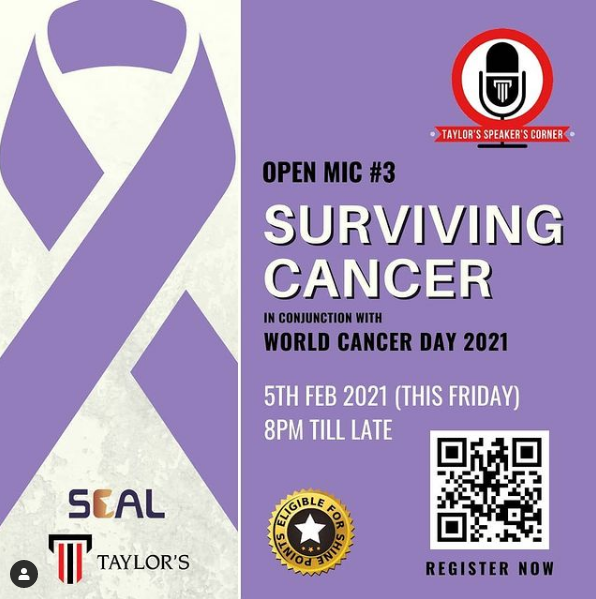
Without even experiencing or witnessing it, we are all aware of how deadly and terrifying cancer can be. However, the experience itself is another story. Being the fourth leading cause of death in Malaysia, cancer patients make up 60 percent of patients in the country. In commemoration of World Cancer Day on 4 February, Taylor’s Speaker’s Corner hosted the Surviving Cancer segment featuring Madam Vijaya.
Official event poster. 
Source: @taylorsspeakerscorner on Instagram.
Madam Vijaya is a breast cancer survivor, now part of the National Cancer Society Malaysia, where she serves as the Head of Volunteer and Clinical Support, providing holistic support and counselling services to not only cancer patients, but also to survivors and caregivers. She has given inspiring talks to a variety of universities, schools and hospitals about her survivorship while spreading awareness about cancer. Moreover, Madam Vijaya has won the Global Hero of Hope Award in 2015, which has led the British Broadcasting Company (BBC) to produce a short film about her story.

Madam Vijaya began the session by sharing her experience from the very beginning: she had a good life, a loving family and her own interior design company. But then she was diagnosed with cancer at 63 years old. Upon discovery of a lump, she took the initiative to get a breast examination. After a mammogram, ultrasound and a biopsy, Madam Vijaya was diagnosed with cancer. Upon receiving the news, she described feeling like a ‘zombie’. Her examination was followed very shortly by the operation, hence the lack of time to process the news, yet all that went through her mind was, “I have to beat this”.

Despite the devastating news, Madam Vijaya expressed that she had never been more grateful to have love, care, empathy and support from her family and doctors throughout the procedure. In fact, it was her doctor who recommended that she become a navigator for other cancer patients.
Madam Vijaya speaking at the event. 
Source: Taylor's Speaker's Corner on Facebook. 
As with any cancer patient, there were both good days and bad days for Madam Vijaya. She lost 30kg through the procedure, took her chemotherapy medication while also dealing with diabetes, high cholesterol and high blood pressure. Furthermore, there was a point of time when her blood sugar was too high and she spent six months on insulin. On good days, she would spend her time viewing recipes, playing sudoku and other games and activities.

A Q&A session followed the talk, in which Madam Vijaya further shared her knowledge and experience. Despite having to carry the weight of her own burden, Madam Vijaya has courageously helped an array of cancer patients whose stories she shared as well.
Source: Evesham Township, New Jersey. 
One might think that everyone is aware of ‘typical’ cancer symptoms, yet Madam Vijaya expressed her frustrations over being stereotyped or misunderstood as a cancer patient. These misconceptions include the myth that cancer is contagious and that men are unable to contract breast cancer (which may be even more traumatic for those affected). Burning questions about cancer such as “Does cancer hurt?”, “Does chemo hurt?”, “Is it ever too late to get treatment?” are also often asked. Madam Vijaya shared that the fourth chemotherapy session is the most painful, thus most patients skip it after the third. Chemotherapy is often more traumatic due to its side effects rather than the pain it causes, to which the audience members agreed.

To summarise the talk and Q&A session, Madam Vijaya strongly encouraged everyone to practise the following, whether they have been affected by cancer or not:

  1. Everyone should educate themselves on the signs of cancer and be aware of the dangers.
  2. Early detection and early treatment is the way to go.
  3. Everything should be done in moderation. Eat intelligently and lead a good life.
  4. If you have a family history of cancer, be more cautious of the risks and your lifestyle.
  5. Women should perform self breast examinations on the seventh, eighth or ninth day after their menstruation cycles.
  6. Don’t take insignificant symptoms too seriously, but take extra caution when symptoms become painful.
  7. If someone you know is a cancer patient, take care of them and help them out; make life easier for them.
  8. Always seek help when needed.

During the current Movement Control Order (MCO), Madam Vijaya has persevered and continued to provide counselling through voice and video calls. Despite the hardships, she shared that her cancer has made her a better person. As someone who has experienced cancer, Madam Vijaya’s talk was not intended to raise fear but rather remind us to be rational with our lifestyles and symptoms, live a good life and to be grateful for every aspect of our lives.
Share
Tweet
Pin
Share
No comments


Masculinity. A word used to represent a set of attributes, behaviors, and roles associated with men. Nowadays, masculinity sparks heated debates as people become more and more aware of the detrimental effects caused by toxic masculinity.
Official Event Poster. Taylor's Student Development

Hence, in honour of World Men’s Day, Taylor’s Speaker’s Corner collaborated with Men Against Toxic Masculinity (MATM) in an open mic session. This event cultivated a virtual community where participants can freely exchange their views about toxic masculinity.

Founded in 2018, MAT organized workshops to help people realize the flexibility of the word ‘masculinity’. They regularly organize a men’s healing group where they would meet up to discuss masculinity and the issues surrounding it. It is a safe space for people to be free from society's unfortunate stigma.

The night began with Rizal Rozhan, the co-founder of MAT, making a distinction between the terms ‘masculinity’ and ‘patriarchy’.

According to Google, he said, masculinity is defined as “the qualities or attributes regarded as characteristics of men”. On the other hand, ‘patriarchy’ refers to a system or a government whereby men hold supremacy over women and exclude them from important decisions.

Rizal also highlighted that the word ‘masculinity’ has a loose meaning as different individuals may come from different standpoints. For example, a man deemed ‘masculine’ may be depicted as someone who is aggressive or rough for one, or kind and gentle for another.

“No matter what they tell us, patriarchy and masculinity are not the same,” expressed Dorian Wilde, a human rights activist and organiser of Taylor’s Speaker’s Corner.

The panelists went on to share what they believe toxic masculinity is in a nutshell.

“One of the many toxic masculinity traits is impunity. They feel like they can do whatever they want without being held accountable,” said Rizal. “No one in their right mind should have this kind of thinking.”

“I think one of the main parts of it is shame,” added Dorian. “It’s the basis of why we as men don’t change.”
Source: Future Women
With the commonization of toxic masculinity, men have also started to adopt the ‘bro code’, a common friendship etiquette which consists of unwritten rules that are to be observed within the social circles of men.

“Every time we question the norm or the ‘bro code’, it’s a form of resistance to these existing structures that have been causing a lot of harm to those who don’t conform to these norms,” said Gavin Chow, an LGBTIQ+ community organiser.

Jannah, an active audience member, described how she felt women contributed to toxic masculinity too. “I know some girls who actually desire this kind of inappropriate attention from guys. We always talk about how men are acting out toxic masculinity, but we don’t think about how women support these ideals as well,” Jannah pointed out.

The crowd also had the opportunity to hear from Sabrina Aripen, founder of SERATA, who openly shared her struggles of dealing with domestic violence from her ex-husband.

“When I did better than him in my subjects while he kept failing, that was when I saw how toxic masculinity contributes to domestic violence, like these expectations of how women should not overstep men and not be so verbal,” she said.
Source: Teen Vogue
“Repression is one of the behaviours often seen in men. They are afraid of judgement. They are afraid of being laughed at. They are afraid of losing power. The inability to express these insecurities and always finding the need to prove themselves in a certain way,” said Kok Sen Wai, a psychiatrist and a member of MATM, who lives by his motto ‘I’m secure so I don’t care’.

With a similar spirit, he also spoke about how men at times act in denial — a result of them not being frank with their concealed thoughts.

“Usually when we do couples’ therapy, I would ask the couple: ‘Why don’t we have a talk with you and your significant other during office hours?’” he explained. “I realised that a lot of these men refused to come because they feel that they do not need the help.”

Rizal suggested that these men could seek help from people they are close to as it is harder for them to open up to strangers.

The blend of insights we’ve received from our speakers has truly illuminated the dark side of masculinity that is rarely brought up during conversations between Malaysians. “With MATM, we wanted to create a support system,” said Rizal. “A lot of men are alien to this concept. Simply challenging them to think differently would be very, very difficult. Unfortunately, the only way to change them is through the people who are close to them.”
Source: The Guardian
To anyone who is struggling with voicing out their problems, it’s important that we form bonds with a trusted community, a group who listens to what we unapologetically have to share.

As Ibnu Mohammed so eloquently put it: “It is time for us to embrace our vulnerabilities. Let’s see everything just as we are, as plain humans, so that everything is on equal ground.”

Firstly, don’t be afraid to speak out against acts of toxic masculinity. In doing so, we make the perpetrator feel uncomfortable and question their actions before possibly damaging words leave their mouth the next time.

It is only by giving will you receive. You may contribute to this issue by participating in events like charities or volunteer work, which will bring us all closer to a world without toxic masculinity.

Finally, you may promote awareness through social media. In our era of globalisation, social media is undoubtedly the most efficient way to spread publicity as it’s a privilege that hundreds of millions have access to. Bringing people together is just one step away from solving this deeply rooted issue that has been plaguing our society. If you are just starting on your journey, consider things like starting a hashtag or forwarding a post to a friend.

In the words of Barack Obama: “All of us have to recognize that being a man is first and foremost being a good human. If you’re confident about your strength, you don’t need to show it by putting somebody else down; show it by lifting somebody else up.”

In conclusion, we cannot solve the issue of toxic masculinity by shying away from it. It all starts with you. Now, how would you like to redefine masculinity?

For those who are interested, here’s a list of resources for further reading.

● What Is Toxic Masculinity?

● The Fantastic Masculinity of Newt Scamander

● Man Enough: The Series (Season 1)

If you’d like to learn more about MATM, feel free to contact Rizal Rozhan at +60133488483 or find him on Twitter @RizalRozhan.
Share
Tweet
Pin
Share
No comments


A heavy topic was brought onto the stage during Taylor’s Speaker’s Corner on the 23rd of October. “Clarity on Disparity” talks about the global issue of economic disparity. Did you know that the world’s richest 1% own 44% of global wealth, while 56.6% of the world population holds less than 2%? This value is staggering. We tackle the implications of this value and what we can do about it with Prof. Dr. Jomo, Mr. Sivarajan, Ms. Archana and last but not least, Mr. Calvin Tan with Ms. Karen Grace Prince, a journalism student at Taylor’s University and the secretary of Taylor's Lakeside Model United Nations Club as our narrator.
Source: https://www.instagram.com/taylorsspeakerscorner/
So, what is this economic disparity? Well, according to IZA, World of Labour, economic inequality is the unequal distribution of income and opportunity between different groups in society. It is a concern in almost all countries around the world and often people are trapped in poverty with little chance to climb up the social ladder.

Photo taken by Johnny Miller at South Africa where Apartheid was implemented.

Source: https://www.diyphotography.net/dramatic-drone-photos-show-thin-line-divides-rich-poor/

The talk started at 8 o’clock sharp with the narrator showing us an incredibly well-made video titled “UN75 - The Biggest-Ever Global Conversation Towards the Future We Want” for the 75th anniversary of the United Nations which was coincidentally two days ago. It had the beautiful message of “shared problems, shared solutions” with appearances from well-known figures such as Greta Thunberg, Millie Bobby Brown and António Guterres. One of the main goals of the UN is to solve the global issue on economic disparity.

Teen climate change activist, Greta Thunberg
Source: Euronews

The mic was then passed to Mr. Calvin, the President of Teach for Malaysia - an independent organization aiming to give all Malaysian children the opportunity to attain excellent education. Mr. Calvin shared some of the heart-wrenching effects of economic disparity had on his students - getting to school half-asleep and falling behind in classes due to the need of taking part-time jobs in their free times. He was also quick to point out how in school, we were always taught of the beautiful sentences about diversity in Malaysia, but never about the disparities.

Source: https://www.instagram.com/taylorsspeakerscorner/
As his closing message, Mr. Calvin prompted the audience to ponder on the following questions:
  • Are we reflecting on the privileges we have, and the ones that we don’t?
  • Are we talking about this enough with other people?
  • Are we the aspiring allies for a person, a target group, or an issue?
  • What actions are we taking today to show up as better aspiring allies?
“The system is not broken. The system is doing exactly what it's designed to do” - Mr. Calvin
After that, Prof. Jomo gave an enlightening answer to the question of how poverty differs from economic disparity. Poverty is a highly specific term that means a sense of deprivation. The lack of natural resources to have a healthy meal, education, healthcare, personal hygiene and daily necessities. An interesting thought was given by Prof. Jomo that happiness is more about inequality than poverty. We tend to think relative to the people around us. “If you are below the poverty line, and you’re in the company of others who are similarly deprived, you may not feel especially deprived.” Economic disparity is the awareness that there’s about 2000 billionaires who could live in ways that many people recognize as at their expense. He also brought onto the table a bigger picture that is less talked about; International economic disparities in Malaysia due to colonization from the west.

Source: https://www.instagram.com/taylorsspeakerscorner/
Moving on, Mr. Sivarajan, the Secretary General of Parti Sosialis Malaysia, gave an eye-opening explanation on what economic disparity is to him. Did you know that there are also disparities within the working class? Mr. Sivarajan added, “A person can go to work for 8 or 12 hours a day, and he is poor. Why is that?”. According to Mr. Sivarajan, the workers of each industry, no matter how insignificant, are all producing value. So why is there such a big difference in distribution in wealth? The salary scales largely from the top of management to the bottom feeders. A director for a government linked company could be earning anything from RM150,000 per month while the lowest ranked worker would only be earning the basic wage of RM1,200. He ended his speech by reminding us how important addressing this issue is as it will perpetuate in the long term.

The next speaker of the night, Ms. Archana is the Asian regional representative for the Commonwealth Youth Council. She focuses on differences in opportunities given to youths in different states compared to “richer” states which have more prominent platforms that many youths from other states have no access to. “Many youths in Malaysia are not given the right cutting-edge experience that they need in policy-making and mission-building processes among so many other things.” She also compared the graduates in Malaysia and their job opportunities depending on where they were born. A graduate at KL could be a top manager while someone in the rural areas could only do a minimum wage job for the same qualifications.

Source: https://www.instagram.com/taylorsspeakerscorner/
Ms. Archana also suggested two contributions youths can make in battling economic disparity. One is to spread awareness by using social media to promote the issue or talk to your friends, parents and have more conversations in general about these so called “uncomfortable conversations”. Secondly, get yourself involved with NGOs. Volunteer yourself!

Ms. Archana suggesting ways youths can help in combating increase of economic disparities
Later that night, a Q&A session started off with a powerful question to the panelists from one of the audience members. Would the relocation of the big companies from the richer part of the country to the less fortunate help in development in those places? Dr. Jomo said that it’s impossible for there to be equal development in all states. This is mainly due to two factors:
  • Supportive facilities. Big corporations would rather have other big complimentary companies around them to create a supportive ecology.
  • Port facilities. Places with a port like Klang Valley, Penang and Johor would naturally have more development than those that do not.
Dr. Jomo answering the question from an attendee  
The meeting zoomed by fast and by the time we knew it, we were listening to the closing quote. Mr. Calvin provided a perfect quote from Mahatma Gandhi to inspire us all to take this issue more seriously; “The true measure of any society can be found in how it treats its most vulnerable members.”

The words said on stage today were something truly special and everyone surely left as a different person. Economic disparity is a global issue that needs more attention from not only the government, but also the youths and everyone in between. For more information, please search google with the keywords; ‘Income inequality in Malaysia’, ’Poverty threshold’ and ‘Teach for Malaysia’.


Taylor’s Lakeside Model United Nations’ mission is to engage in an authentic simulation of the United Nations system by learning about the UN system, the skills of debate, promise, conflict resolution, and negotiation while having fun learning about the workings of world diplomacy through the lens of current events. For more information, please contact them at munclub.tlc@gmail.com.

The Speaker’s Corner is under the purview of Student Engagement Leadership Development (S.E.A.L.), Student Development, Centre for Future Learning. For bookings, enquiries or collaborations, please contact Mr. Dorian Wilde at Dorian.Rajoo@taylors.edu.my.

Share
Tweet
Pin
Share
No comments


Such mystical topic indeed spurs our imaginations to the beyond and the vast emptiness of space.

‘What is it like out there?’

‘Do aliens truly exist?’

...

  Before getting carried away with infinite possibilities and theories, let’s listen to a tale not too far from us. 

A tale grounded in the roots of aspirations and ambitions; Vanajah’s tale. 

On October 2nd, Taylor’s Speaker Corner and Taylor’s Astronomical Society hosted an open mic event titled “Tales from Outer Space”. This was held in conjunction with World Space Week 2020 which aims to ‘provide unique leverage in space outreach and education’. 

Guest speaker, Vanajah Siva, graced the event by sharing her adventure on how she succeeded to be one of the four finalists in Malaysia’s ANGKASAWAN program in 2006. 

The ANGKASAWAN program was a joint-governments-initiated program by Malaysia and Russia to select one Malaysian representative to send to the International Space Station (ISS). 

For 32 years old Vanajah with unfulfilled dreams of being a pilot, this was her opportunity to reach beyond the skies. To reach the stars. 

And so, she became one of the 11,275 applicants in 2003. 

Two years later, she was called to participate in the ‘Run to the Orbit’ test where she finished 3.5 km in 19 minutes. 

After numerous fitness tests, health check-ups and psychological evaluations, she was accepted into phase 2, Aeromedical II. 

Here, she underwent further health screenings and this time, it was coupled with the altitude chamber and human centrifuge.  


Altitude chambers are designed to prepare people to brace the low oxygen conditions at high altitude to prevent hypoxia. 

(Taken from Vanajah’s Slides) 


Aviators and astronauts undergo High-G training using the centrifuge to prepare them to face high gravitational and atmospheric pressure. In the spinning centrifuge, they are subjected to high levels of acceleration ('G') and may experience a g-induced loss of consciousness (G-LOC) due to blood flow away from the brain. 

(Taken from the European Space Agency) 

Was the challenge over? 

No. 

From a total of 27 candidates in Aeromedical II, only 18 were chosen for the ‘Sea and Land Survival’ test at Malaysia Navy Base (TLDM) in Lumut. 

Left at sea after being toppled from boats, they swam to shore and thought they were done. 

They weren’t. 

Face plastered on the ground and bodies submerged in swamps, the (yawns) sleep-deprived candidates braced the nocturnal jungle with only a rope as guidance. 

Vanajah shared that they had to memorize a Malay poem, write their names on an unnervingly wrapped figure and recite it when they return. 

Finally, four finalists were chosen and sent to Russia where they were recognized as qualified astronauts after a string of medical tests and evaluations. 


The Four Angkasawan Finalists. From left, Mohammed Faiz, Dr Sheikh Muszaphar, Vanajah Siva and Dr Faiz Khaleed. 

(Source: The Star Newspaper) 

On October 10 in 2007, Malaysia’s representative Dr Sheikh Muszaphar boarded the Soyuz TMA-11 spacecraft with the Expedition 16 crew and was launched into space. 

Throughout the open-mic event, the audience piqued with immense curiosity, and addressed several questions to Vanajah. 

“Did you have any second thoughts during the whole process?” 

    “Absolutely not. Never once did I think it was not for me. I loved every minute of it. People always         asked me: Aren’t you scared? What if you die if the rocket explodes? Well, there’s actually an even       higher possibility of me dying in a car crash than from a rocket explosion. The point is people die.          What matters is what you are doing when you die.” 

“How does it feel when you are experiencing hypoxia?” (hypoxia is a symptom resulting from prolonged exposure to low oxygen levels.) 

      “Not good” She chuckled. “I felt drunk but without the high and everything was in slow motion.” 

“How did your life change after the entire process?” 

      “I was devastated when I was not selected as the final two. Completely heartbroken. I did not leave         the house for a month.” 

With absolutely no compensation from the government, young Vanajah who also quit her job for ANGKASAWAN was homebound for a month. After such an out-of-this-world experience, how could she return to a mundane life? 

She received many invitations to be a guest speaker at community events. At first, Vanajah was very hesitant because she could not fathom why. 

    “Why would you want to see me? I failed. I didn’t get selected.” 

Fortunately, she took a leap of faith and attended one event. There, people, young and old; women and men, all of them were in awe of her. Finally, Vanajah realized that she was not a complete failure. She is a phenomenal woman who has accomplished such an amazing feat in a decade where women were not highly recognized in STEM. 

During her sharings, Vanajah mentioned the difficulties of being a woman in STEM in Malaysia. Although opportunities were there, societal ideals on those who should have occupied these vacancies were relatively backwards during the 20th century. 

Fortunately, the pathways for Malaysian women in STEM have opened up in recent years. Examples of prominent Malaysian women in STEM includes Dr Siti Kayriyyah Mohd Hanafia (a scientist who won top prize in the FameLab International 2018 competition in United Kingdom), Shu Lam (the scientist who solved the superbug problem at the tender age of 25 years old ) as well as Pearl Wendy Mak, Wang Wen Chien, and Nur Hidayah (they are the first female pilots for Malaysia Airlines). 

After a member from the audience highlighted the fact that Malaysia Airlines have appointed female pilots in 2018, Vanajah wondered why it took this long for us to have female pilots. 

Lastly, she emphasized that STEM in Malaysia especially the astronomy field is relatively rudimental with so much potential and that young Malaysians should step up and be the catalyst for STEM in Malaysia no matter their ethnicity, gender and status quo. 

As the night was still young, the event continued with a dialogue revolving around the World Space Week 2020 theme; “Satellites Improve Life”. 

According to Chris Leong, the President of Taylor’s Astronomical Society, satellites are important for TVs, radios and GPS. 

Adding to that, Mr Dorian raised the concern of ‘blowing up’ used satellites which have led to a ring of space debris surrounding Earth. 


Before indulging further, what is space debris and why is it a concern? 

Chris Leong shared his insight. “Space debris can range from dust to full-on exploded rocket parts. Many may think that the exploded rocket parts are dangerous. It is not.” 

He continued. 

“It is actually the space dust that is dangerous because the ISS moves at a really high speed. Even at this small mass, the large relative velocity would exert a large force on the ISS. The ISS can calibrate their flights to miss those space debris, but they cannot entirely avoid the space dust. Hence, space dust is actually the problem.” 

Metaphorically comparing these space dust as bullets, Mr Dorian also voiced out that space debris is not just an issue to the Space Station (ISS) for this could lead to potential situations in which future space excursions would not be ideal. 

When asked how the issue of space debris can be resolved, Hoh Shan from the audience had something to say. 

“We can make the rocket sturdier or promote reusability like what Elon Musk has done. Solutions that don’t require decoupling the rocket and fewer explosions needed to eject the rocket out of space,” said Ho Shan. 

Other solutions considered were using magnets, nets, lasers, disposing space debris into the sun and even using them as building materials back on Earth. 

Well, to fellow readers, what is your take on this issue? 

(Taken from SkyNet Magazine) 

Although the astronomy field remains relatively novice in Malaysia, it is one with much potential for growth as humans' appetite for knowledge is insatiable. 

To all astronomy enthusiasts who wish to pursue a career in this field, go for it. 

As what Vanajah said, “I'm just like you. If I could do it, so can you.”

________________________________________ 

Taylor's Astronomical Society aims to promote and deepen the interest of astronomy among its members and other Taylorians, as well as serve as a bridge between professional astronomers, amateur astronomers and laymen. For more information, kindly visit their Instagram page @taylors_astronomical_society. 

The Speaker’s Corner is under the purview of Student Engagement Leadership Development (S.E.A.L.), Student Development, and Centre for Future Learning. For bookings, enquiries or collaborations, please contact Mr Dorian Wilde at Dorian.Rajoo@taylors.edu.my.
Share
Tweet
Pin
Share
No comments


2020 has seen an interesting, if not a little outrageous shift in Malaysian politics. The people have witnessed an abrupt change of government, the dismantling of various political alliances, as well as the possible formation of a youth-led coalition. As these political uncertainties build up, and many people, especially the youth, have felt that it is time for true government reform. 

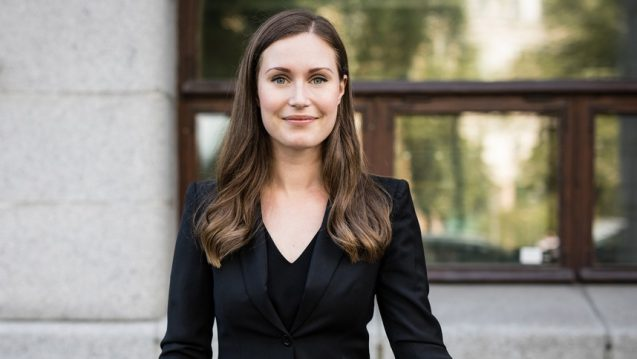
Arguably, there is no better time for youths to enter the political sphere. Recent years have seen the rise of young politicians such as Finland’s Sanna Marin, who became the world’s youngest Prime Minister, and US Congresswoman Alexandra Ocasio-Cortez, who defeated a 10-term incumbent through a grassroots campaign. 
 
Sanna Marin, a Finnish politician, is the world’s youngest Prime Minister. 
 Source: State of the Planet 

Alexandria Ocasio-Cortez, US Representative for New York’s 14th Congressional District 
Source: The Hollywood Reporter 

These fiery young people have ignited a flame within the hearts of many youths, especially since most older politicians have turned a blind eye towards issues like climate change and unemployment. 

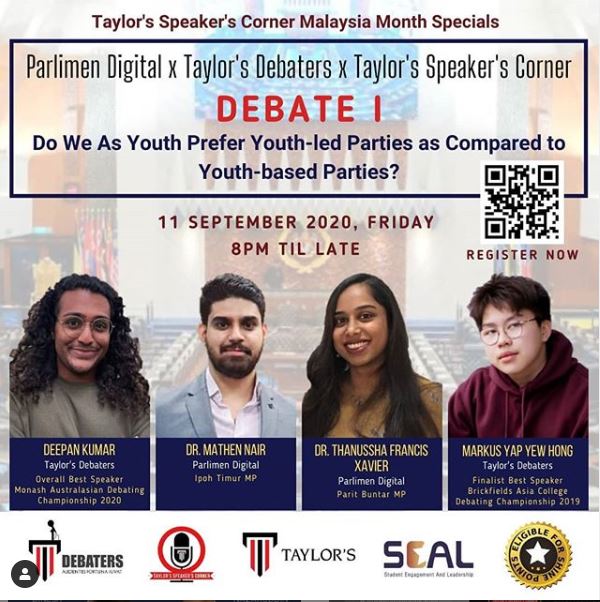
Therefore, on the night of 11 September, Taylor’s Speaker’s Corner hosted an event to debate the question: Do young people prefer youth-led parties that include politicians of all ages, or do we need a party just for Malaysian youths? 

Official poster for the event. 
Source: @taylorsspeakerscorner (Instagram) 

Hosted by Taylor’s Debater Har Naveenjeet Singh, the mock debate was a collaboration with Taylor’s Debaters and Parlimen Digital, an initiative by ChallengerMY, Undi18 and LigaRakyat Demokratik which gives young people an opportunity to speak out on policy reforms. 

The night saw an interesting lineup of speakers. Championing youth-led parties, Dr Mathen Nair from Parlimen Digital and Deepan Kumar, Taylor’s Debater spoke for the side of the government. As for the opposition, Dr Thanussha Francis Xavier from Parlimen Digital and Markus Yap, Taylor’s Debater argued for youth-based parties. 

As the terms ‘youth-led’ and ‘youth-based’ were used frequently in this debate, it is important to make a distinction between the two. Youth-led parties refer to coalitions where the majority of representatives are young people, but still includes senior politicians. Whereas youth-based parties are made entirely of youths, with the exclusion of other age groups. 

Source: The Evanstonian 

One might be tempted to think that the choice is obvious: Surely youth-led parties are the right way to increase youth advocacy? The experience of senior members, coupled with the connections they’ve established, would certainly push the party to greater heights, Dr Mathen and Deepan Kumar claimed. 

And who can deny that seniors have generally accumulated more wealth as compared to the youths? This makes them valuable assets to youth-led parties, as they can provide resources and funding that the young people could otherwise struggle to put together. 

Besides, an entirely youth-based party is virtually unheard of, and likely to face ridicule—not just from older politicians but the public as well. Youth-based parties could also be shunned as radical. 

But the opposition has also put forth several arguments for youth-based parties that sound perfectly reasonable. “A youth-led party is just tokenism,” Dr Thanussha said, claiming that these coalitions would ultimately be taken over by senior members. “How much of that translates to the youths having an actual, concrete say in the party itself?” 

She also argued that Malaysia’s ageism culture will inevitably diminish youths, citing the example of Syed Saddiq being heckled by the older Members of Parliament, where the representative was called ‘cucu’, which means grandson. 

YB Syed Saddiq heckled by MPs in Parliament debate 
Source: Malaysiakini 

“The superiority of older adults is ingrained within Malaysian culture, and the existence of this may drown out youth voices,” agreed Markus Yap. “Allowing seniors into the parties allows them to drown out our voices.” 

Moreover, there is a danger that the policies put forward by youth-led parties may originate from the seniors, but presented in a manner that appeals to the youth. This type of legislation will not benefit young people, he reasoned. 

Source: kindpng 

So, why the need for youth parties? 

A common sentiment from all the speakers was that youths are able to better empathize with the people’s needs. 

“There has never been a political party solely for youths,” Dr Thanussha said. “Thus, it hasn’t been easy for us to champion our needs and concerns.” Though arguing for youth-based parties in the mock debate, she personally believes in youth-led coalitions. Furthermore, Dr Thanussha claimed that youths are more adaptable to change, which is a necessary quality in parliament. 

“A youth-based party would consist of people who are constantly consuming information, as opposed to the seniors who are merely consolidating information.” She argued that youths are more tech-savvy as compared to the seniors, citing the slow development of the contact tracing app MySejahtera during the COVID-19 pandemic. 

Source: Parents 

However, several audience members expressed that age should not be the main consideration when it comes to politics. Instead, competency and knowledge should be prioritized. 

“That is a fair argument. While it is true that we cannot vote solely on the basis of age,” Deepan responded, “I do think that youth parties would [serve as an important starting point for youth advocacy]. It is an attempt to repair many of the problems we’ve had in the past, with regards to youth representation.” 

Some have also questioned the system for youth coalitions. “Can members of youth parties still be members when they’re no longer youths?” 

“I would not implement an age limit, because that is, again, age discrimination,” answered Dr Thanussha. “Rather, I would consider term limits.” Other speakers also agreed that term limits are necessary in any political coalition. 

Source: FES Asia 

How should we increase youth political involvement?

Despite the growing spotlight on young politicians, we see youths becoming more apathetic towards politics. Statistics show that about 4.2 million Malaysians have not registered to vote, and with the voting age lowered to 18, young people would be thrust onto the scene with little to no knowledge of politics. 

How, then, do we get young people politically involved? 

“Start having conversations about politics with your peers,” Dr Thanussha answered. “Go to your community and ask them about their needs. Provide solutions that they agree with in order to help them. And most importantly, vote.” 

Source: BBC 

But there is, undoubtedly, much opposition awaiting young politicians. Unfortunately, Malaysian culture is one that views young people as less capable. “How do we break this stigma?” asked another audience member. “And how do youth parties intend to disrupt age discrimination?” 

“The way I look at it, the moment a youth party is started, the stigma is already broken,” Dr Mathen replied. “When youths form a movement, they’re basically taking a stand for their future and fighting for what is relevant to them.” 

“It is about the people.”

There is no denying the need to highlight certain issues that are being sidelined in Parliament today, such as climate change and the flawed education system. But that’s easier said than done. 

“Decisions regarding these issues cannot be federal,” Dr Mathen insisted. “People who are subject experts—technocrats, environmental specialists and so on—these are the people who need to be included in policy reforms. That way, we can ensure that the policies implemented will truly make a difference.” 

“We need representatives who go and ask questions, who get to know the needs of the people,” said Dr Thanussha, who was travelling with Dr Mathen to the Peninsular East Coast for a political outreach as she spoke. She argued that right now, no one is speaking about the issues faced by the community there, such as poor internet connection and unemployment. 

“The point of youth parties is not to just advocate for young people,” she continued. “Rather, it is to change the way politics work in Malaysia. It’s not about Party A vs Party B; it is about the people.” 

Source: Kitsap Youth Activism Team 

Youth political involvement should be a topic more often discussed in Malaysia, and Taylor’s Speaker’s Corner has provided a platform for that. Despite their differing opinions, the speakers and audience members unanimously agree that youth parties are necessary, regardless of whether the majority are youths, or the party consists of young people only. 

Young people see their communities’ needs, and with their fresh ideals, they can meet those needs. It is important that they enter the political landscape—not with the intention of gaining power, but to address real problems faced by their constituents. With that, they have the chance to forge a better future—for themselves, and the generations to come.
Share
Tweet
Pin
Share
No comments
Older Posts

Follow Us

  • Facebook
  • Instagram
  • TikTok

Search

Subscribe to Our Monthly Newsletter!

Contact Form

Name

Email *

Message *

About Us

Etc Magazine

Etc. Magazine is all about bringing you the latest news and updates on various topics, all from the urban Malaysian student’s point of view.

By Taylorians, For Taylorians.

Category

#Survivingcollege101 Creative Writing Culture Enough is Enough Events Festive Ringgits for Thoughts Social Awareness Speaker's Corner Sports

Popular Posts

  • KASHMIR LOCKDOWN: NOT A CONSEQUENCE OF CORONA | BY ZAIN UL ABEDEN
  • Dancing 6 ft apart: Dancers share their stories on surviving Covid-19 | BY NUR SAFFEA ERNADY
  • Transcending the Boundaries of Filmmaking in Echo Film Fest 2023 | By Shree Pavana Kurunsikumaran
  • I’M THINKING OF ENDING THINGS: REDEFINING THE HORROR MOVIE SCENE I By Liew Yen Rou
  • How to Survive College as a Broke Student | By Jane Law

Created with by BeautyTemplates